Get a Free inspection when you sign up.
Best Roof Ventilation for Miami Homes: How Proper Attic Airflow Protects Your Roof and Lowers Heat
In Miami, roof ventilation is easy to ignore until the attic turns brutally hot, the upstairs feels harder to cool, or moisture problems begin showing up around the roof system.
If you are searching for the best roof ventilation for Miami homes, you are really asking how to protect your house from one of South Florida's biggest daily stressors: trapped heat and moisture. Homeowners often focus on shingles, tile, underlayment, and hurricane resistance, which all matter. But ventilation is one of the hidden system details that affects comfort, roof longevity, attic conditions, and how hard your air conditioning has to work through the hottest months of the year.
In South Florida, proper attic airflow is not a luxury feature. It is part of building a roof system that can handle intense sun, year-round humidity, sudden rain, and long cooling seasons. A well-ventilated roof helps release excessive heat from the attic and reduce moisture buildup that can quietly damage decking, insulation, fasteners, and other roofing components over time. That is why ventilation deserves just as much attention as the visible roofing material on top.
Why roof ventilation matters more in Miami
Miami attics can become extremely hot, especially under dark roofing materials and during long stretches of direct summer sun. When that heat has nowhere to go, it builds beneath the roof deck and increases temperature stress on the entire assembly. Over time, that can accelerate material aging, dry out vulnerable components, and make the rooms below less comfortable than they should be.
Humidity is the other major factor. South Florida homes are constantly dealing with moisture in the air, and attics need a reliable path for heat and moisture to escape. Without that airflow, condensation risk increases, insulation can perform worse, and wood components may stay exposed to damp conditions longer than they should. The best roof ventilation for Miami homes is the system that creates balanced, consistent airflow instead of letting the attic become an oven by day and a moisture pocket by night.
Common signs your attic airflow may be inadequate
Poor ventilation does not always announce itself with one dramatic symptom. More often, homeowners notice a pattern. Upstairs rooms stay hotter than the rest of the house. Cooling bills climb without a clear explanation. The attic feels unbearable within minutes. During an inspection, a contractor may find signs of heat stress, damp insulation, mildew concerns, or premature wear on roofing components that should still have more useful life left.
You may also see indirect warning signs around the roofline itself. That can include moisture staining near the decking, musty odors, warped sheathing, rusting fasteners, or roofing materials that seem to age faster than expected. None of those issues automatically prove ventilation is the only problem, but they are good reasons to look beyond the surface before paying for repeated repairs.
Ventilation issues can show up on newer roofs as well as older ones. A roof can be beautifully installed on the surface and still underperform if the intake and exhaust strategy is weak, blocked, or mismatched to the house. That is why ventilation should be assessed as a system rather than treated like a single vent added here or there.
What balanced roof ventilation looks like
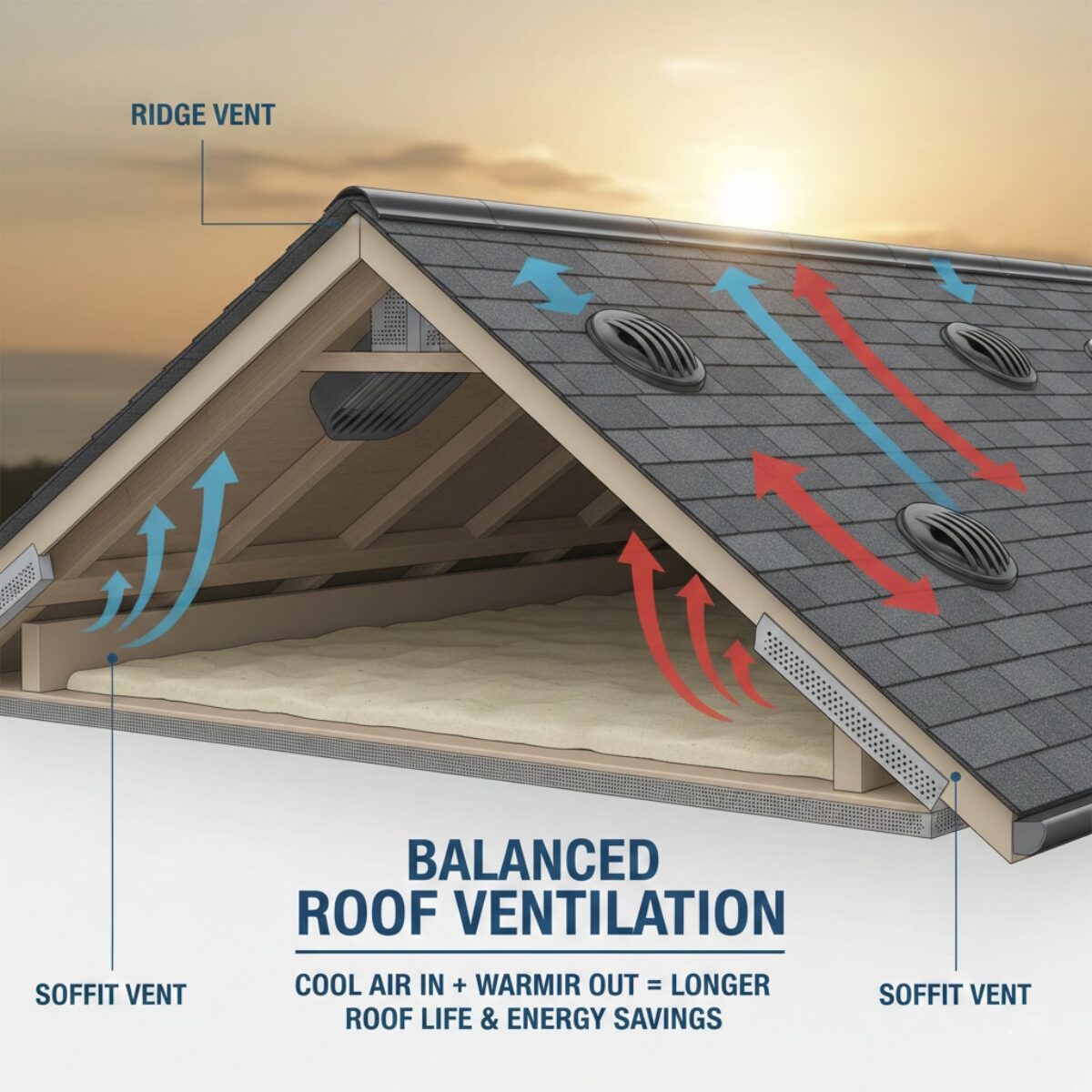
The best roof ventilation for Miami homes usually includes both intake ventilation and exhaust ventilation working together. Intake vents, often located lower on the roof or at the soffits, allow cooler outside air to enter the attic. Exhaust vents, typically placed higher near the ridge, allow hot air to escape. When those two sides are balanced correctly, the attic can cycle air more efficiently instead of trapping it beneath the roof deck.
This matters because ventilation is not just about cutting more openings into the roof. Too much exhaust without enough intake can reduce performance. Poorly placed vents can leave sections of the attic stagnant. Blocked soffits can choke the system even when ridge vents are present. Good ventilation design depends on roof shape, attic size, insulation layout, and the roofing material being used.
Every roof type has its own details. Shingle roofs, tile roofs, and some low-slope roof assemblies may use different ventilation strategies, but the goal stays the same: move heat and moisture out in a controlled, code-conscious way that supports the life of the roofing system.
Which roof ventilation options work best in South Florida
For many sloped Miami homes, soffit vents paired with ridge vents are among the best-performing solutions when the roof design allows it. This setup supports natural airflow, keeps ventilation distributed instead of concentrated in one small area, and usually looks cleaner than relying only on box vents or scattered retrofit additions. When designed properly, ridge-and-soffit systems can help release attic heat more evenly across the roof.
Some homes use off-ridge vents, static box vents, gable vents, or power ventilation such as attic fans. These can be appropriate in certain situations, especially when roof geometry, existing construction, or retrofit limitations make a ridge-and-soffit layout harder to achieve. The right choice depends on how the home is built and whether the current ventilation strategy is helping or fighting itself.
In Miami, ventilation upgrades should always be approached with storm durability in mind. Vents need to be compatible with the roof system, installed correctly, and selected with local weather exposure in mind. Cheap shortcuts can create weak points instead of solving the heat problem. A professional roofing contractor should evaluate ventilation together with flashing details, underlayment condition, and roof age so the solution is built for South Florida conditions, not borrowed from a colder market.
How poor ventilation can shorten roof life
Excess attic heat can push roofing materials to work harder every day. Shingles may age faster under repeated thermal stress. Underlayment and sealants can be exposed to harsher conditions. Even tile systems can suffer when the assembly beneath them holds unnecessary heat and moisture. Ventilation does not stop a roof from aging, but it can reduce some of the pressure that speeds aging up.
Moisture is just as concerning. A poorly ventilated attic can contribute to damp insulation, wood movement, and hidden deterioration that homeowners do not notice until stains, odors, or decking issues appear. In some cases, what looks like a simple roofing problem is partly an airflow problem underneath. That is one reason repeated repairs can disappoint when the ventilation imbalance is never addressed.
When ventilation upgrades make sense during roof replacement
One of the smartest times to improve roof ventilation is during a roof replacement. That is when the entire assembly is already being opened up, inspected, and rebuilt. If your current roof has signs of trapped heat, attic discomfort, or premature wear, replacement is the perfect time to correct those weaknesses instead of reinstalling the same problems beneath a brand-new roof.
Ventilation upgrades can also make sense even when you are not ready for full replacement. If your roof still has useful life left, a contractor may be able to improve airflow through targeted corrections. The key is diagnosing the real cause first. Not every hot attic needs the same fix, and adding a powered vent without addressing intake can create a disappointing result.
Why ventilation should be evaluated with the full roof system
Ventilation should also be considered alongside insulation, roof color, underlayment, decking condition, and the age of the system. A Miami roof works as a package, not as a collection of unrelated parts. If the home has blocked soffits, failing flashing, or storm wear near penetrations, those issues can affect how well ventilation improvements perform. The best results come from looking at the whole system instead of chasing one symptom at a time.
That is especially important for homeowners planning a sale, preparing for hurricane season, or trying to lower long-term maintenance costs. A roof that breathes properly is generally easier to maintain, less likely to trap hidden moisture, and better positioned to deliver the service life the material was supposed to provide in the first place.
The bottom line for Miami homeowners
If you want the best roof ventilation for your Miami home, the answer is not one universal vent product. It is a balanced design that fits your roof type, attic layout, and South Florida weather exposure. Good ventilation helps support roof longevity, reduce trapped heat, improve attic conditions, and make the home below more comfortable.
If you are dealing with a hot attic, rising cooling costs, or concerns about roof performance in Miami-Dade, Broward, or Monroe County, contact All Pro Contractors for a professional roof inspection and ventilation review. We can help you determine whether the issue is ventilation, roofing age, storm wear, or a combination of factors so the next step is clear and worthwhile.
FOLLOW US


Navigation
Services
LEGAL
OUR CERTIFICATIONS
Copyright 2026. All Pro Contractors Inc License No CGC1525217 & CCC1333865. All Rights Reserved.